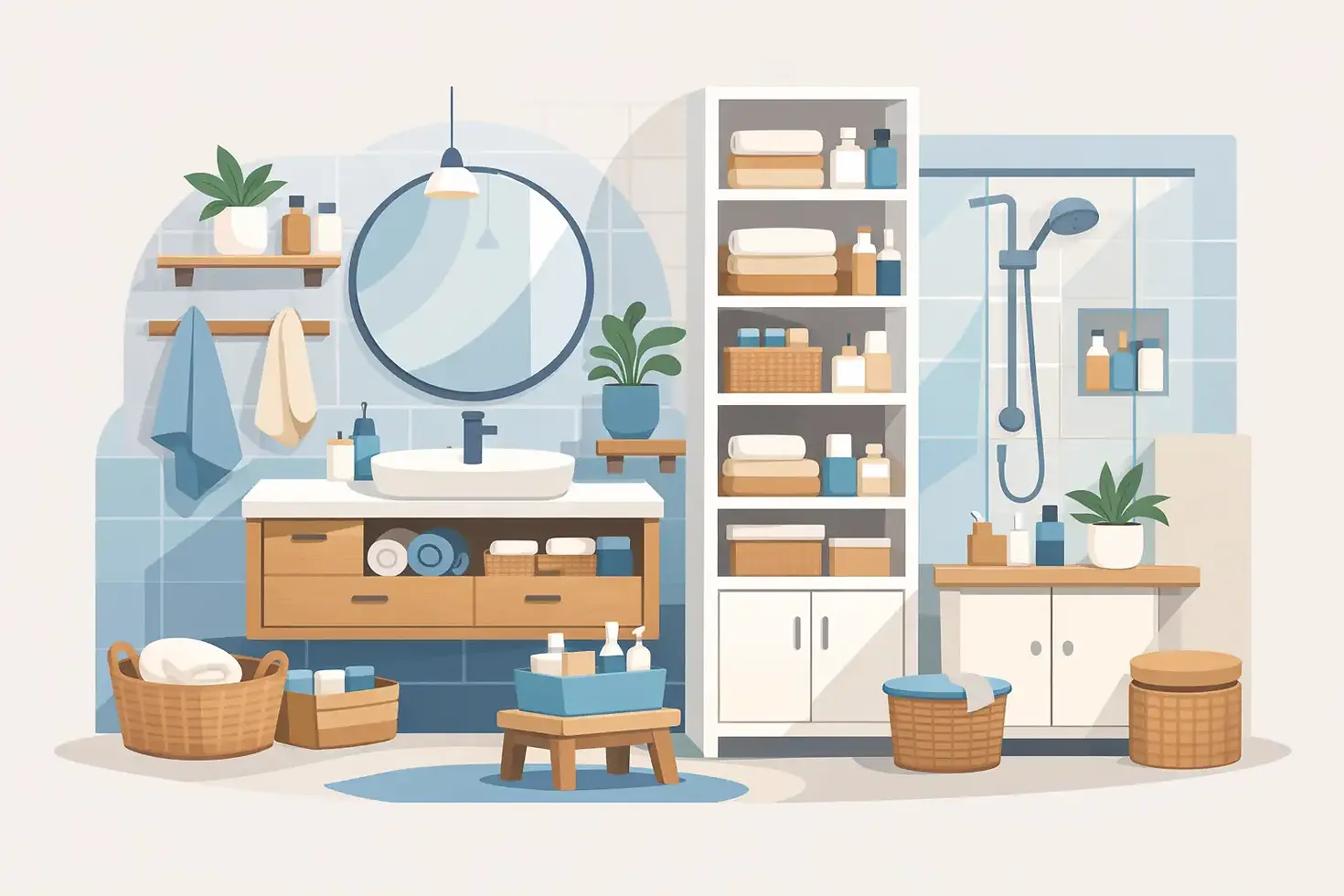
Small Bathroom Storage Planning That Works
The problem with most small bathrooms is not only that they are small. It is that the storage is usually treated as an afterthought, then expected to solve everything. A recessed niche gets added late, a vanity is chosen from a showroom range, and somehow the room is meant to hold daily toiletries, towels, cleaning products, hair tools, cosmetics and spare paper without looking crowded. Good small bathroom storage planning begins much earlier, at the point where layout, movement and joinery are being considered together.
That distinction matters. Storage is not a shopping exercise. It is a design exercise. And in a compact bathroom, design quality makes a very visible difference because every compromise is amplified.
Why small bathroom storage planning often fails
Many bathrooms end up with technically adequate storage but poor real-life usability. There may be drawers, but not the right depths. There may be shelves, but they sit in the wrong zone. There may be a mirrored cabinet, but it projects too far into the room or interrupts the overall visual balance.
This is where the market often falls short. A cabinet supplier can tell you what sizes are available. A sales showroom can show you a vanity suite. Neither approach necessarily addresses how the room should function for the people using it every day. A well-resolved bathroom needs more than cabinet selection. It needs someone to think through what belongs in the room, who uses it, how often, and how much visual calm the client wants to preserve.
In practical terms, a family bathroom and an ensuite may be similar in size yet require completely different storage planning. One may need room for children’s bath items, multiple toothbrushes and extra towels. The other may prioritise uncluttered surfaces, concealed charging, and enough depth for skincare and grooming products. The dimensions are only part of the brief.
Start with what actually needs to live in the room
Before planning cabinetry, it helps to define the storage categories honestly. Most small bathrooms are being asked to store more than people realise. Daily-use items need immediate access. Backup stock should be close but not visually dominant. Less attractive necessities such as cleaning products, toilet paper and bins still need proper accommodation.
This is why generic solutions often disappoint. If you choose a vanity because it looks right but never consider whether your electric toothbrush, hairdryer or spare hand towels fit comfortably, the bathroom will return to benchtop clutter very quickly. A beautiful room can still feel unresolved if the everyday objects have nowhere sensible to go.
The most useful planning question is not, “How much storage can we fit?” It is, “What needs to be accessed here, and how should it be accessed?” That shift changes the layout.
The vanity is the anchor, but not the whole answer
For most bathrooms, the vanity carries the main storage load. That does not mean a larger vanity is always the right move. In a tight room, an oversized unit can make circulation awkward, crowd the toilet zone or interrupt the visual lightness that helps a small space feel generous.
The better approach is to get precise about configuration. Drawers are usually more efficient than cupboards because they allow full visibility and easier access to smaller items. Internal organisation also matters. Deep drawers can become catch-alls unless they are divided intelligently. Shallow top drawers, where possible, are especially useful for grooming items and smaller bathroom essentials.
A wall-hung vanity can make a compact room feel larger because more floor remains visible. It also creates a lighter architectural line. But floor-mounted joinery can sometimes offer more internal volume. Which option is best depends on the room proportions, plumbing constraints and the visual character you want. There is no universal rule. The right answer sits at the intersection of function and composition.
Depth matters more than many people expect
One of the most common mistakes in small bathrooms is selecting vanity depth without considering the room in section, not just in plan. If the vanity projects too far, it narrows movement and can make the room feel immediately cramped. If it is too shallow, storage capacity suffers and benchtop usability may be reduced.
This is where custom thinking becomes valuable. A carefully resolved depth can preserve circulation while still delivering practical drawer space. Even small dimensional changes can materially improve comfort.
Use the wall space properly
In compact bathrooms, vertical space is often underused or used poorly. Open shelving is a common example. It can look attractive in styled photography, but in many real homes it becomes visual noise unless the household is disciplined and the stored items are limited. That may suit some clients, but not all.
Concealed wall storage tends to age better. A recessed mirrored cabinet can provide substantial day-to-day storage without taking floor area. If it is proportioned well and integrated into the broader design, it can feel architectural rather than added on. The detailing matters here. Thickness, door alignment, lighting relationships and mirror scale all contribute to whether the result looks refined or merely functional.
Shower niches also need restraint. They are useful, but they are not a substitute for broader storage planning. A niche should hold the products needed in the shower, not become a display shelf for every bottle in the household. Oversized or poorly positioned niches can look heavy and disrupt tile setting, especially in a smaller room.
Think in zones, not pieces
Strong bathroom design comes from planning storage by use zone. The basin zone should support grooming, handwashing and daily personal care. The shower zone should house shower-specific items. The toilet area may need discreet access to spare paper and cleaning supplies. Towel storage should sit where it can be reached naturally without making the room feel overfilled.
When these zones are considered early, the bathroom feels easier to use because objects are stored where they are needed. When they are ignored, even a bathroom with reasonable cabinet volume can feel awkward. You notice the towel hook in the wrong place, the toothbrushes cluttering the benchtop, and the lack of a clear home for practical items.
This is the difference between filling a room with storage and actually designing one.
Small bathroom storage planning and visual calm
Storage is not only about capacity. It is also about what the eye sees. In a small bathroom, visual calm is a form of function. If every product is on display, the room feels tighter and less resolved, no matter how expensive the finishes are.
That is why concealed storage is often worth prioritising over decorative add-ons. A properly integrated mirrored cabinet, a vanity with well-planned drawer internals, and discreet niches or recesses will usually deliver a cleaner outcome than relying on baskets, trolleys or freestanding accessories introduced after the fact.
There are trade-offs, of course. Fully concealed storage can make a room feel more minimal, but some clients prefer a little openness for display or easy access. The answer depends on how the bathroom is used and how tidy its users realistically are. Good design is not about imposing a stylistic rule. It is about creating a room that suits the household and still holds its visual discipline.
Materials, maintenance and longevity
Bathroom storage also has to cope with moisture, heat and frequent use. This sounds obvious, yet it is another point where superficial planning can fall down. Internal finishes, door construction, hardware quality and ventilation all affect how well storage performs over time.
A beautifully drawn vanity with poor internal specification is not good design. Likewise, mirrored cabinets and niches need careful detailing so they are durable and easy to maintain. The best storage solutions are not only efficient on day one. They continue to function well after years of daily use.
For clients investing in a renovation, this is where specialist design leadership is worth far more than product selection alone. At 5 Rooms, the focus is not on fitting in as many cabinets as possible. It is on resolving the room so storage, movement, proportion and finish quality all work together.
What to prioritise when space is genuinely tight
If the bathroom is very compact, priorities become sharper. Daily-use storage should come first. The vanity and mirrored cabinet usually do the heavy lifting. Beyond that, any additional storage needs to justify itself spatially and visually.
Sometimes the smartest move is to store bulk items elsewhere, such as in a linen cupboard or adjacent laundry, rather than forcing every bathroom-related item into one room. That is not a failure of planning. It is often a sign of disciplined planning. A small bathroom does not need to hold everything if that compromises the room.
The goal is not maximum storage at any cost. The goal is a bathroom that feels composed, efficient and generous relative to its size. That takes more than standard cabinetry. It takes judgement.
If you are planning a bathroom renovation, treat storage as part of the architectural thinking from the start. The room will work harder, look calmer and feel far more considered every single day.


Comments